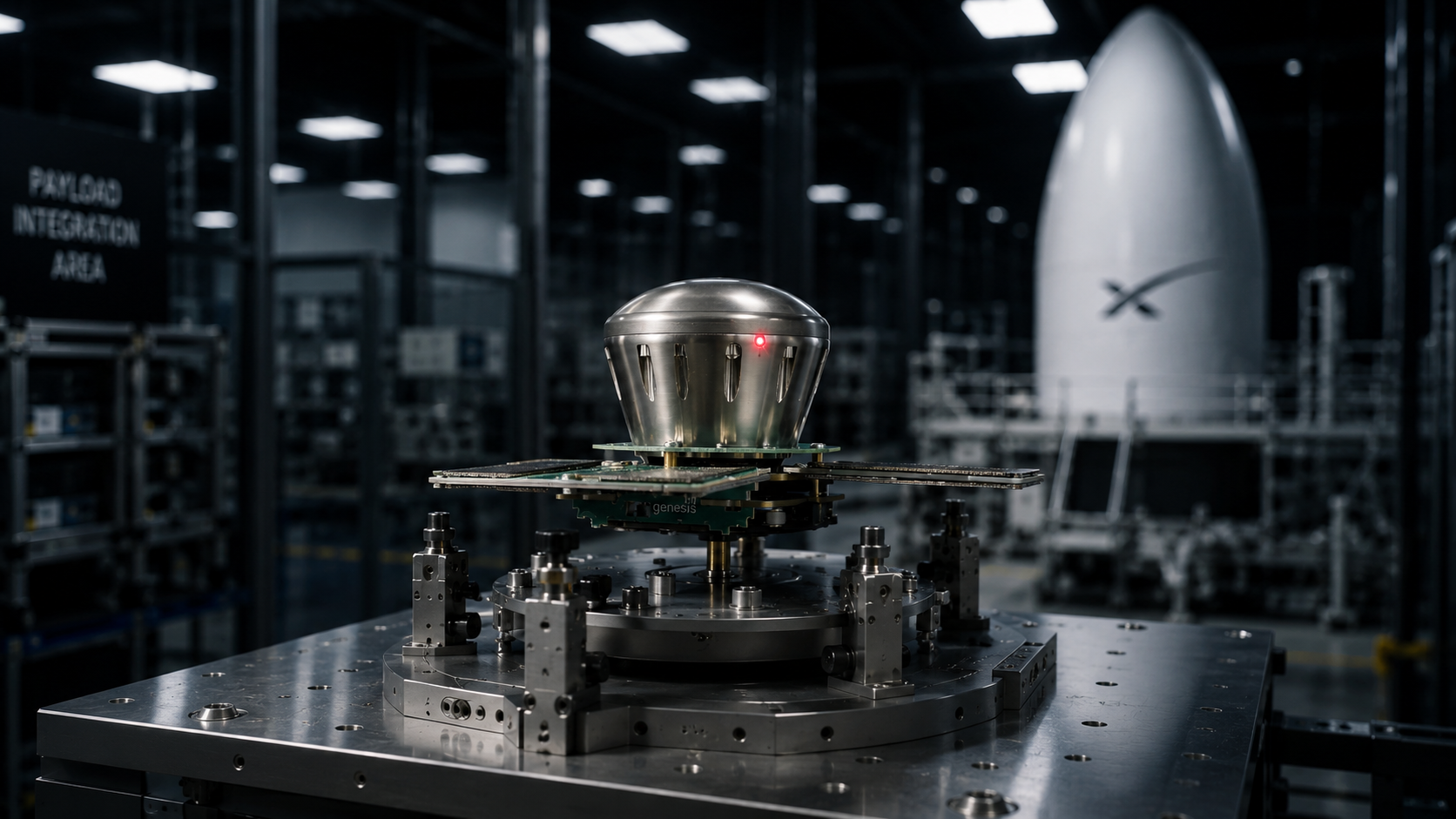
MISSION: MG-J26 Horizon
STATUS: Payload Integration
DATE: 2026-04-06
MG-J26 Horizon is the second Martian Grow orbital mission. Three cannabis cultivars are manifested. Payload integration is underway. Launch is scheduled for June 27, 2026.
This article covers what is confirmed, what is in progress, and what happens after the seeds return.
The mission at a glance
MG-J26 carries three seed lots into low Earth orbit aboard a Genesis II SFL capsule. The seeds will remain in orbit for approximately nine months, exposed to cosmic radiation and microgravity continuously throughout that window. Recovery is planned for late 2026, after which the scientific program begins.
The mission follows MG-J25 Genesis (June 2025), which reached orbit but did not return seeds, and MG-J26-T Pathfinder (May 2026), the suborbital test flight that validated the recovery chain. MG-J26 carries the lessons from both.
What is on the manifest
Three cultivars were selected through the Martian Grow community nomination process. Round A of the naming community received 847 votes across four candidates. The top three by vote count are manifested on MG-J26:
Chemdog — 312 votes. Original Chemdog lineage. Nominated by the community for its documented chemical stability and historical significance as a foundational American genetics line.
Durban Poison — 198 votes. South African landrace. Selected for its distinct terpene profile and geographical isolation, which makes it a clean genetic baseline for comparative analysis.
Hindu Kush — 141 votes. Pakistani landrace. One of the most geographically stable landrace populations documented in cannabis genetics. Selected as a control-adjacent baseline with minimal hybridization history.
Each cultivar was characterized pre-flight. Baseline grow-outs establish the genetic and chemotypic starting point against which post-flight returnees will be compared.
Why these three
The selection criteria were not arbitrary. Matched controls require a stable, well-characterized baseline. Landrace genetics and established lines offer that stability. If a seed lot shows significant within-line variation before the mission, attributing post-flight divergence to orbital exposure becomes statistically difficult.
Chemdog, Durban Poison, and Hindu Kush each offer documented lineage depth, reasonable within-line uniformity, and chemotype profiles distinctive enough to detect divergence against.
They also represent three distinct genetic backgrounds: American, African, and Central Asian. If orbital exposure produces heritable changes, comparing outcomes across three divergent backgrounds increases the probability of detecting whether the effect is cultivar-specific or more general.
What payload integration involves
Integration is the process of preparing the seed lots for launch. It is not a single step.
Seeds are packaged in flight-rated containers that maintain viability through launch, orbital exposure, and recovery. Every container is sealed with tamper-evident materials. Every seed lot receives a unique identifier that follows it through the entire chain of custody, from pre-flight characterization through post-flight germination and assay.
The identity system is not administrative overhead. It is the mechanism that makes any post-flight scientific claim defensible. Without unbroken chain of custody, the source of any observed variation cannot be attributed to orbital exposure rather than handling, contamination, or sample mix-up.
Matched ground controls are prepared simultaneously. Control seeds from the same lots are packaged identically and stored under controlled terrestrial conditions for the same duration as the flight window. The comparison between flight and control populations is the foundation of every analytical conclusion the program will draw.
What the nine months in orbit mean
Seeds do not actively grow during orbital exposure. They are in a dormant, packaged state. The exposure is passive; the seeds are subject to whatever the orbital environment delivers over the nine-month window.
That environment delivers two primary variables.
Cosmic radiation in low Earth orbit includes high-energy protons and heavy ions that produce clustered DNA damage at frequencies not replicated by terrestrial radiation sources. The biological effect of this damage depends on whether cellular repair mechanisms in the seeds resolve the lesions correctly when germination begins post-recovery.
Microgravity removes the gravitational cues that plant cells use to organize their developmental signaling. Over nine months, this may alter gene regulatory states in ways that persist after germination. Whether any such changes are heritable is one of the central questions the program is designed to answer.
Nine months is the target exposure duration because it represents a meaningful dose window. Shorter missions in the published space plant biology literature have documented measurable effects. Nine months exceeds most prior exposures in the literature for seed-state material, which is part of why MG-J26 data will be novel regardless of outcome.
After recovery
Seeds return in late 2026. Recovery procedures have been revised based on the MG-J25 experience, with additional contingency protocols for the recovery phase specifically.
Post-recovery, the program runs in sequence:
Germination and viability assessment. Flight seeds and ground controls are germinated under identical controlled conditions. Germination will be assessed post-recovery.
Phenotypic screening. Plants are grown through a full cycle. Morphology, flowering time, growth rate, and yield are documented against baseline characterization data.
Chemotype profiling. Targeted metabolomics via LC-MS/MS profiles cannabinoid and terpene composition for every candidate. Results are compared to pre-flight baseline and matched ground controls.
Candidate selection. Plants showing divergence from matched controls advance to the next analytical layer. Plants within baseline variation are documented and archived.
Multi-omics on candidates. Selected candidates undergo whole-genome sequencing, RNA sequencing, and DNA methylation profiling. The goal is to understand the mechanism behind any observed divergence, not just the phenotypic outcome.
Reproducibility gating. Candidates must demonstrate stable divergence across multiple propagation cycles before they qualify as licensable cultivars. A single interesting grow-out is not sufficient. The program requires evidence that the observed traits are heritable and consistent.
What this mission will and will not tell us
MG-J26 will generate the first multi-omic dataset of cannabis exposed to nine months of orbital conditions with matched controls and pre-registered hypotheses. That is new. Nothing comparable exists in the published literature.
What it will not do is prove that orbital exposure causes specific traits in cannabis. That claim requires the attribution hypothesis (H5) to be validated, specifically, that the combined orbital stressors produce biological outcomes not explained by either variable independently, and not attributable to handling or storage effects. H5 validation requires at minimum two missions of data.
MG-J26 is the first data point. MG-O26 Catalyst, scheduled for October 2026, is the second.
What we are looking for in MG-J26 data is signal: measurable, reproducible divergence from matched controls that is consistent with the orbital stress hypothesis. Whether we find it, at what frequency, and in which genetic backgrounds is what the mission is designed to determine.
The answer comes from the grow-out, not the launch.
Martian Grow Research
martiangrow.com/journal/mg-j26-mission-update