Science
Cannabis has 12,000 years on Earth. Zero in orbit. The orbital environment is the variable. Everything that comes back gets measured across six layers.

Space breeding is not new. Cannabis has never been part of it.
Since 1987, China has flown more than 3,300 seed experiments and released over 260 commercial crop varieties from material that travelled to orbit and back. Luyuan 502 wheat — bred from space-flown seed — yields eleven percent more than its terrestrial parent and is one of the most widely planted varieties in the country.
Cannabis has never been part of it. Until now.
MG-J26 Horizon carries a contracted payload of cannabis seeds to low Earth orbit for approximately nine months. They are exposed to two things at once.
Radiation breaks DNA. Microgravity flips the switches.
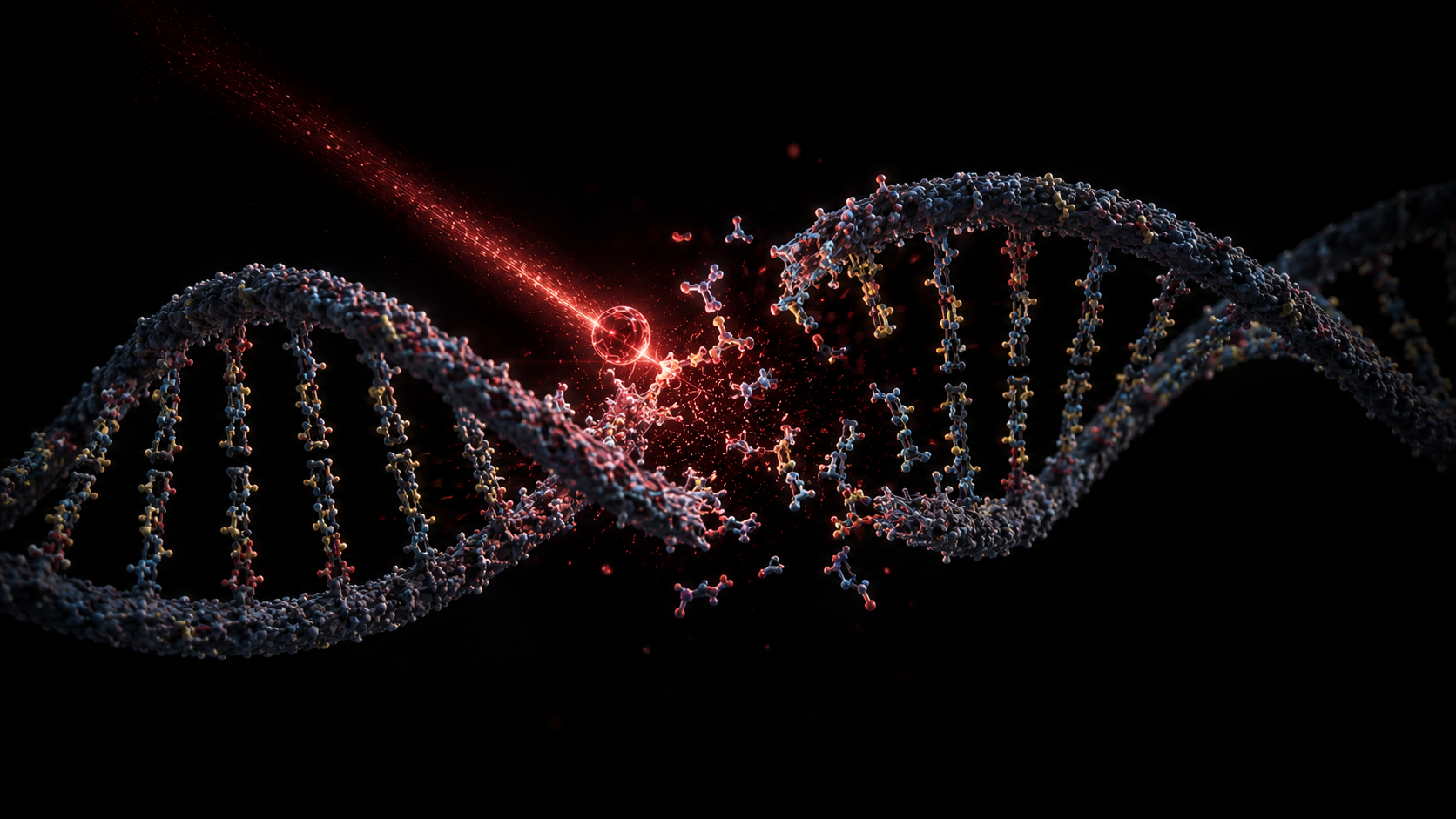
Heavy ions. Bullets through DNA.
Iron, carbon, and oxygen nuclei moving at near light speed punch through double-stranded DNA. The cell repairs the breaks sloppily — gluing broken ends, deleting letters, rearranging chunks. That sloppy repair is where new traits come from.
Permanent mutations. They pass on through the seed line.
Epigenetic reprogramming.
No mutation to DNA itself. Methylation patterns shift, silent genes wake up, jumping genes lose their locks. NASA confirmed: plants use epigenetic changes to adapt to spaceflight. Block that ability and they perform worse.
Reversible shifts. Locked in through cloning, not seed.
Knockouts are useful. Heavy ions make clean ones.
Shotgun.
Gamma radiation on Earth causes small, scattered point mutations. A protein gets damaged but rarely disabled. High kill rate, low yield of useful variation.
Bullet.
Heavy ions create focused, large structural breaks. Clean knockouts. Whole genes disabled cleanly. Most useful crop mutations in history are loss-of-function — including Luyuan 502.
It is not space that is magic. It is the heavy ion particles.
Structure first. Chemistry later.
Loss-of-function.
A gene gets knocked out. The plant gets better. Most successful crop mutations in modern agriculture — from semi-dwarf wheat to Luyuan 502 — are loss-of-function.
First wins: compact plants, stronger stems, faster flowering, stress tolerance.
Gain-of-function.
A gene picks up new activity. Rare from random mutation. Most chemistry shifts — big potency jumps, new cannabinoid ratios — sit here.
Longer game: big potency jumps, new chemotypes.
Every plant. Six layers. Full provenance.
No editing. No insertion. No CRISPR.
Send. Wait. Look. Keep.
If you phenotype-hunt from seed, you understand this method.
Do the changes pass on?
New genetics.
Traits stay in the line. Cultivars stabilise over generations. First named cultivars from the programme target a 2027 to 2028 horizon.
First baseline.
First multi-omic baseline of cannabis under sustained orbital exposure. Published. Every future mission reads against it.
One mission is a snapshot. Six missions are a time series.
Scientific Foundation
Spaceflight precedents, microgravity biology, and the body of research the programme builds on.
Martian Grow Whitepaper
The platform thesis end to end: closed-loop architecture, evidence chain, IP economics, and what compounds across missions.