Heavy ions vs gamma rays
Not all radiation is the same. A chest X-ray and a supernova remnant both involve energy passing through matter, but the damage profiles are fundamentally different. In breeding, the type of radiation determines the type of mutation, and the type of mutation determines whether the result is useful or just wreckage. Space breeding works not because seeds go to orbit, but because of what hits them when they get there. The interesting part is not the destination. It is the particles.
What are heavy ion particles?
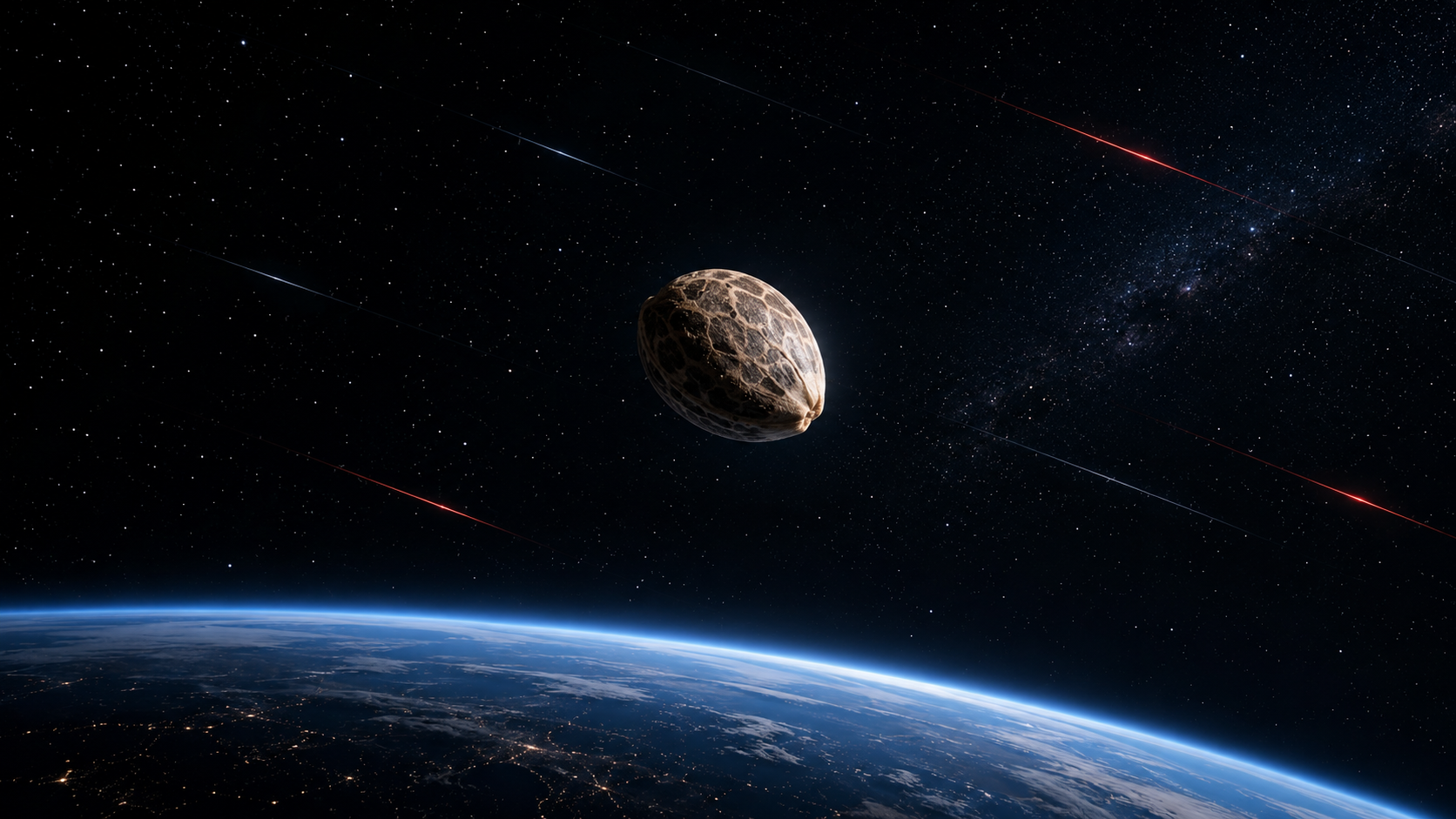
HZE particles. The acronym comes from High atomic number (Z, from the German word Zahl) and High Energy. These are not photons. They are actual physical objects: nuclei of atoms heavier than helium. Iron nuclei. Carbon nuclei. Oxygen. Silicon. Stripped of their electrons, accelerated to near light speed by the shockwaves of ancient supernovae [ref: hze-origin].
They travel across the galaxy as galactic radiation. On Earth, the atmosphere absorbs most of them. In orbit, above the atmosphere, they reach seeds directly [ref: atmospheric-shielding].
They make up only about 1 percent of space radiation by particle count, but they are the most biologically significant component [ref: hze-fraction].
What are gamma rays?
Gamma rays are electromagnetic radiation. Pure energy. Photons with zero rest mass, traveling at light speed. They sit at the highest-energy end of the electromagnetic spectrum, beyond X-rays, beyond ultraviolet [ref: gamma-definition].
On Earth, gamma irradiation has been the standard mutagenesis tool for decades. Point a cobalt-60 source at seeds, blast them with photons, grow out the survivors, select the useful mutants. It works. Over 3,000 crop varieties worldwide have been developed using gamma or X-ray mutagenesis [ref: iaea-mutant-varieties].
How does a gamma ray damage DNA if it has no mass?
A photon carries energy even without mass. When a gamma-ray photon collides with an atom in or near a DNA molecule, it transfers energy to an electron, knocking it out of its orbit. That ejected electron breaks chemical bonds [ref: ionization-mechanism].
Two pathways. Direct effect (roughly 20-30 percent of damage): the photon ionizes DNA directly. Indirect effect (roughly 70-80 percent): the photon splits a water molecule near the DNA into reactive oxygen species, hydroxyl radicals, which attack the DNA strand [ref: direct-indirect-damage].
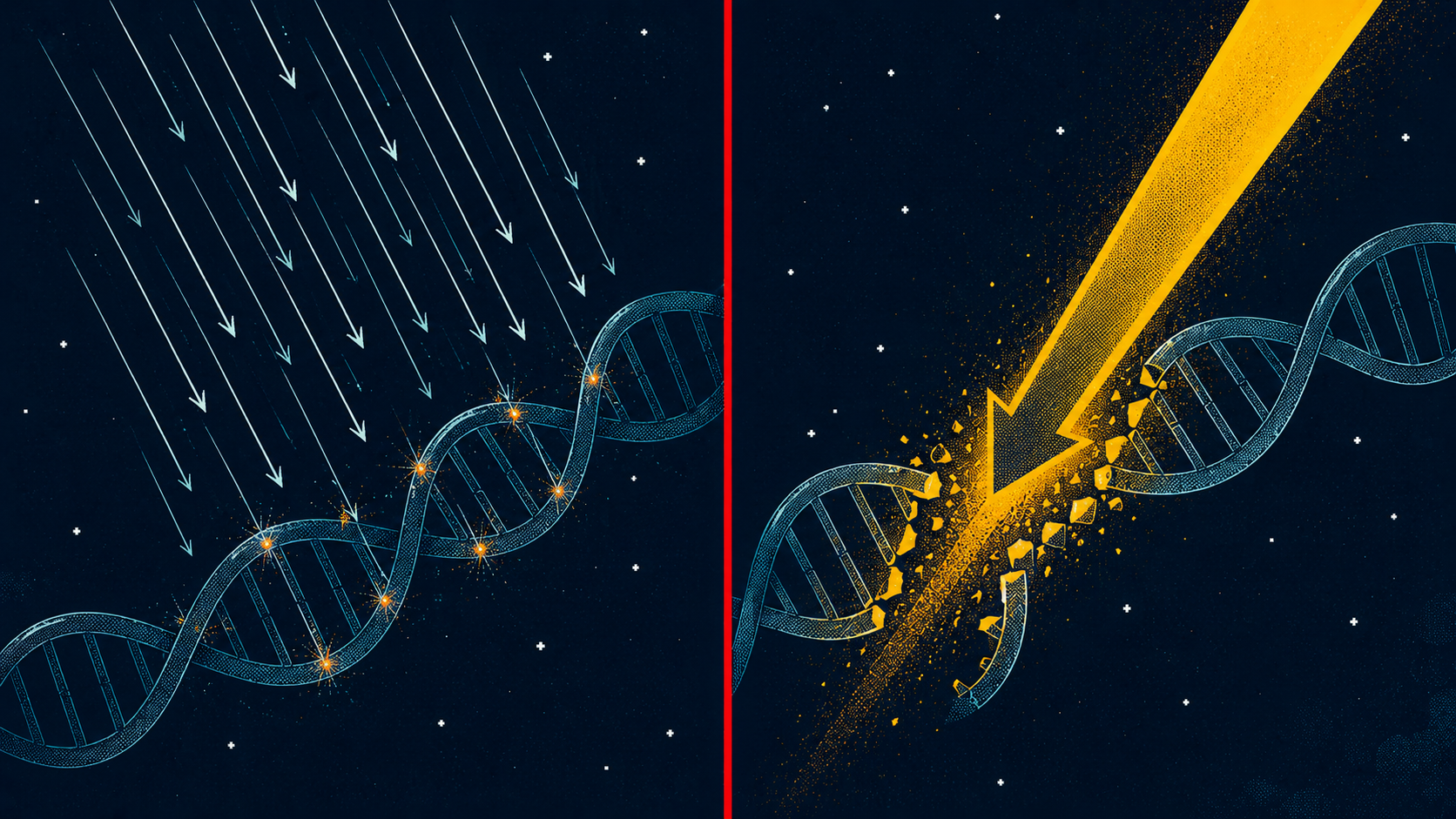
The result is usually a single-strand break. One side of the DNA ladder snaps. The other side holds. The cell repairs it using the intact strand as a template. Repair is accurate. The mutation, if any, is small: a single nucleotide changed, a point mutation [ref: ssb-repair].
Scattered damage. Many small hits across the genome. Like a shotgun.
How does a heavy ion damage DNA?
A heavy ion is not energy. It is matter. An iron nucleus is roughly 56 times heavier than a single proton. Moving at 50-90 percent of the speed of light, it carries enormous kinetic energy concentrated in a very small cross-section [ref: hze-mass-energy].
When it passes through a cell, it deposits energy along a narrow, straight track. Physicists call this Linear Energy Transfer (LET). Heavy ions have high LET: dense ionization along every nanometre of the track [ref: let-definition].
When that track crosses a DNA molecule, the damage is concentrated. Both strands of the double helix break at the same location. A double-strand break. The ladder does not just crack on one side. It snaps in two [ref: dsb-mechanism].
Often the damage is even more complex: multiple breaks clustered within a few base pairs, plus oxidative damage to the surrounding nucleotides. Clustered lesions. The cell cannot use the opposite strand as a template because both strands are destroyed in the same region [ref: clustered-damage].
One straight line of destruction. Like a bullet.
How does the cell repair a double-strand break?
Two systems.
NHEJ (Non-Homologous End Joining). The fast method. The cell detects the broken ends, holds them together with scaffold proteins, and glues them back. No template. No proofreading. Letters get deleted. Short sequences get inserted at random. Chunks of the chromosome get rearranged. The repair works, the cell survives, but the DNA sequence at the break site is altered. That alteration is a mutation [ref: nhej-mechanism].
NHEJ is the dominant repair pathway for double-strand breaks in plant cells, especially in seeds where no sister chromatid is available as a reference copy [ref: nhej-plants].
Homologous Recombination (HR). The slow, accurate method. The cell uses a homologous DNA sequence (typically the sister chromatid during cell division) as a template to rebuild the broken region. Faithful repair. Rarely produces mutations. But HR requires a template, which dormant seed cells often lack [ref: hr-mechanism].
Heavy ion damage routes primarily through NHEJ. Sloppy repair. That is the mechanism that generates the mutations breeders care about.
Why does the damage profile matter for breeding?
The history of crop improvement reveals a pattern: most of the mutations that made crops better were loss-of-function mutations. A gene knocked out. A protein no longer produced. The plant improved because something was removed, not added [ref: loss-of-function-review].
Gamma rays produce mostly point mutations. A single nucleotide substituted. The gene still functions, but slightly differently. A damaged protein rather than an absent one. Damaged proteins are unpredictable. They may fold incorrectly, interact with unexpected partners, or retain partial activity that interferes with cellular processes [ref: point-mutation-effects].
Heavy ions produce large deletions. Chunks of DNA removed entirely during NHEJ repair. The gene is gone. The protein is absent. Clean loss of function. The cellular consequence is straightforward: one protein missing, one pathway interrupted. Predictable. Testable. Breedable [ref: large-deletion-hze].
This is why the distinction matters. The bullet produces cleaner knockouts than the shotgun.
Can heavy ion radiation be replicated on Earth?
Partially. Particle accelerators can generate beams of heavy ions. Facilities like HIMAC in Japan and GSI in Germany do this for radiation biology research [ref: accelerator-facilities].
But there are constraints. An accelerator produces a single ion species at a controlled energy. Orbital radiation delivers a full spectrum of ion species across a range of energies, arriving from all directions (isotropic), continuously, for the duration of the mission. Replicating that diversity and duration requires either multiple accelerator runs at different settings or accepting that the ground experiment is an approximation [ref: spectrum-comparison].
Cost is the other constraint. A heavy-ion accelerator facility costs 30-50 million euros to build and hundreds of thousands per year to operate. A rideshare payload slot to orbit costs 800-2,000 euros per kilogram [ref: cost-comparison].
The full orbital environment, heavy ions plus lighter particles plus microgravity plus duration, remains cheaper to access than to simulate.
What this means in practice
When a seed sits in orbit for weeks or months, it absorbs hits from the full particle spectrum. Most hits are protons and electrons (low LET, minor damage, easily repaired). A small fraction are heavy ions (high LET, double-strand breaks, complex lesions, sloppy repair, large mutations).
That small fraction is what makes orbital mutagenesis distinct from ground-based irradiation. Not more mutation. Better mutation. Larger structural changes that cleanly remove gene function rather than subtly damaging it.
The bullet, not the shotgun. That is the mechanism. Everything else in space breeding follows from it.