What radiation do seeds encounter in orbit?
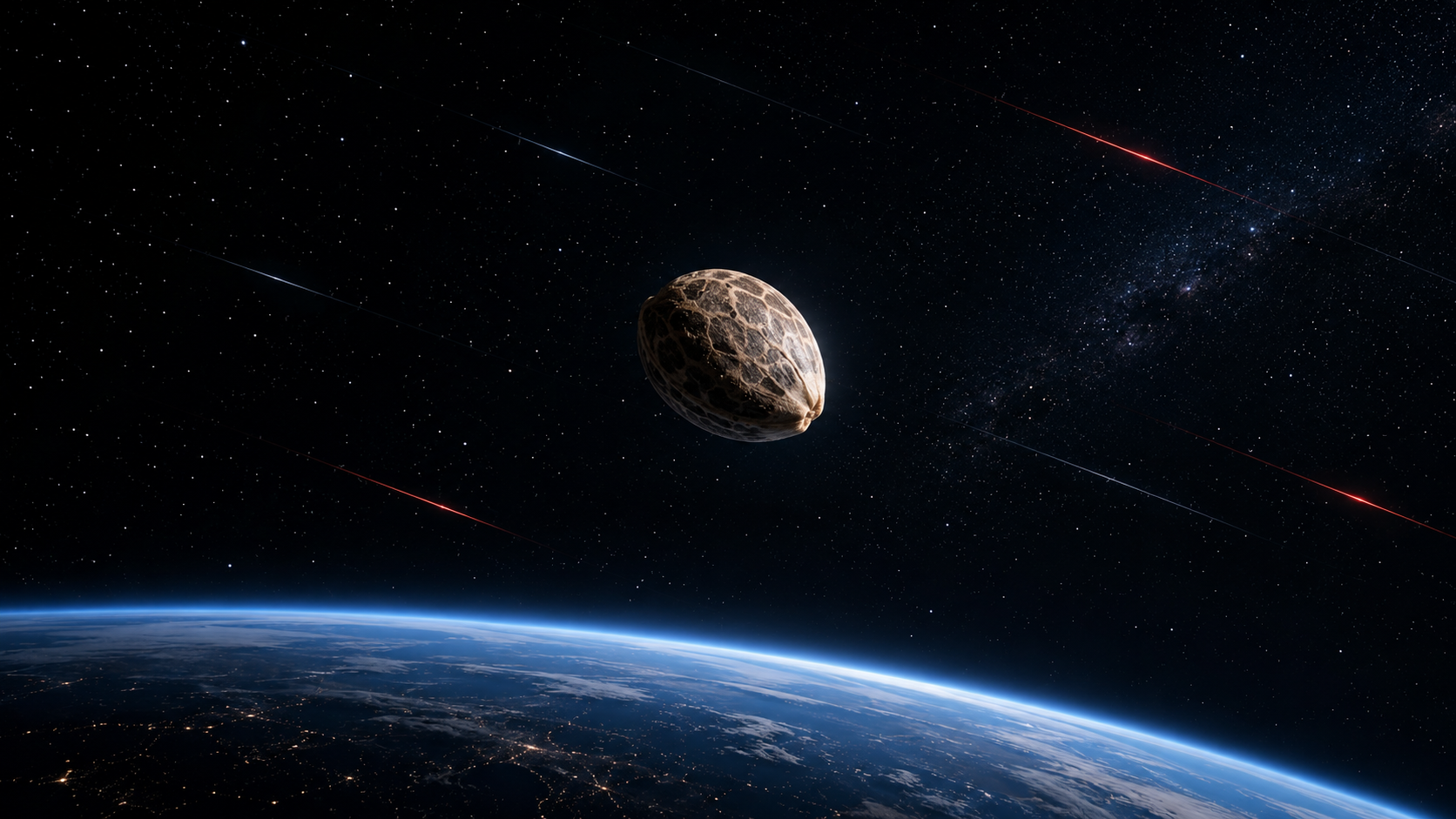
The phrase "radiation in space" suggests a uniform field, like background music in a room. The reality is nothing like that. Low-Earth orbit is a layered, anisotropic, time-varying radiation environment where the dose a seed absorbs depends on the orbit's altitude, its inclination relative to the equator, the phase of the 11-year solar cycle, the shielding mass of the spacecraft, and whether a solar particle event happens to occur during the mission. Two missions at different altitudes in the same year can deliver meaningfully different radiation profiles to identical seed payloads. Understanding what seeds actually encounter matters because the mutation spectrum depends on the particle types and energies that reach the DNA.
What are the sources of radiation in LEO?
Three primary sources contribute to the radiation field in low-Earth orbit [ref: leo-radiation-sources].
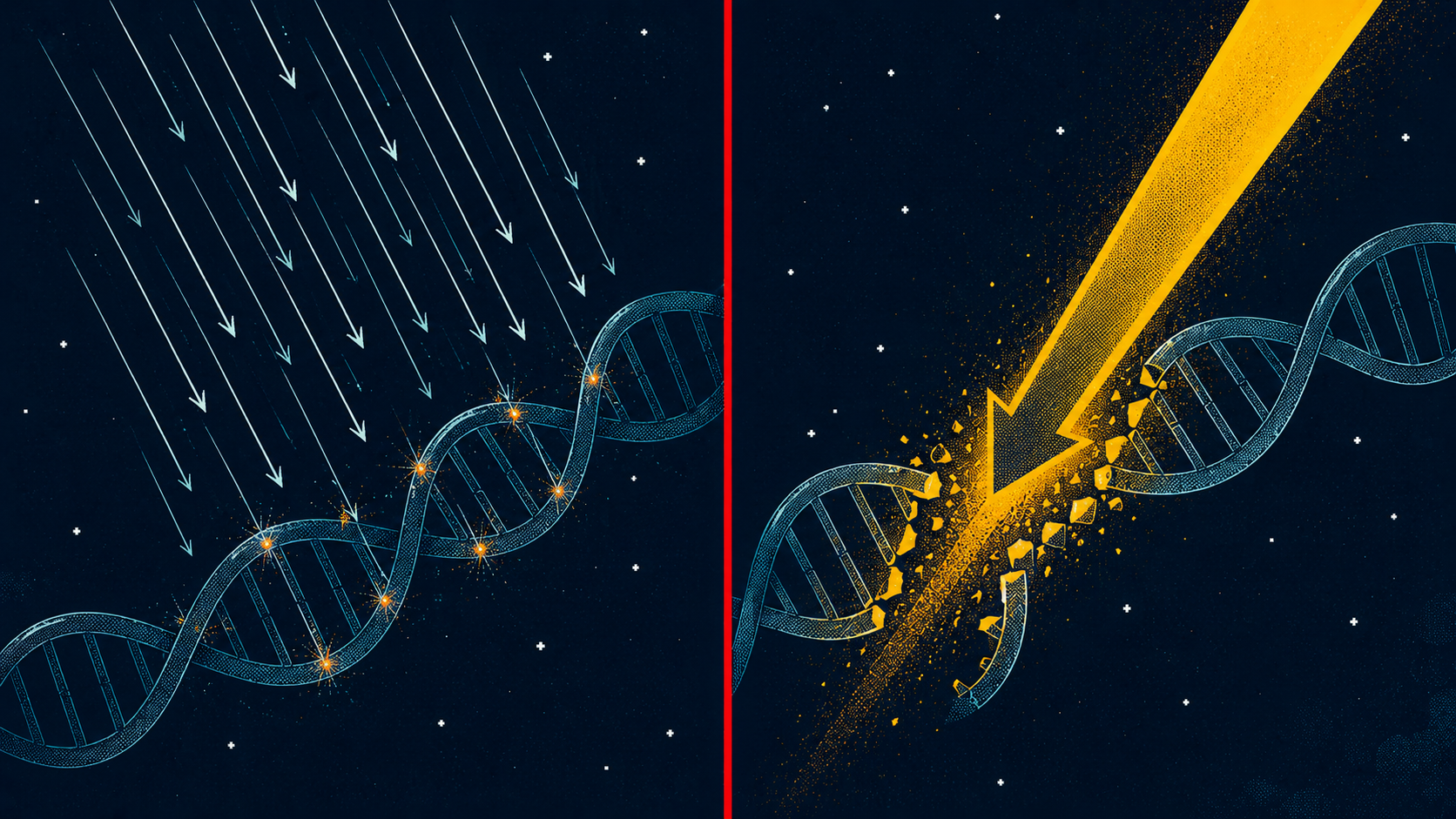
Galactic radiation. Particles originating outside the solar system, accelerated by supernova remnants and other high-energy astrophysical processes. The spectrum includes protons (about 87 percent), helium nuclei (about 12 percent), and heavier ions called HZE particles (about 1 percent). The HZE fraction is small by count but disproportionately important for biological effects because each particle deposits far more energy per unit length than a proton [ref: gcr-composition].
Trapped radiation. The Van Allen belts are zones of charged particles (mostly protons and electrons) trapped by Earth's magnetic field. The inner belt extends from roughly 1,000 to 6,000 kilometres altitude. Most LEO missions orbit below the inner belt at 400-500 kilometres, but the South Atlantic Anomaly (SAA) is a region where the inner belt dips to lower altitudes due to the offset between Earth's magnetic and rotational axes. Spacecraft passing through the SAA encounter elevated proton fluxes [ref: van-allen-belts].
Solar particle events. The Sun periodically releases bursts of high-energy protons and heavier ions during solar flares and coronal mass ejections. These events are sporadic and unpredictable. A mission that coincides with a major solar event will receive a higher acute dose than one that does not. Solar particle events are more frequent during solar maximum, which occurs roughly every 11 years [ref: solar-particle-events].
How much radiation do seeds absorb?
The International Space Station orbits at approximately 420 kilometres altitude and 51.6 degrees inclination. The typical dose rate inside the ISS is 0.3 to 0.5 milligray per day, depending on solar activity and shielding. Over a nine-month mission, seeds would accumulate approximately 80 to 135 milligray of total absorbed dose [ref: iss-dose-rates].
For comparison, the natural background radiation dose on Earth's surface is roughly 2.4 milligray per year. Seeds in orbit for nine months receive roughly 30 to 55 times the annual terrestrial dose, compressed into a shorter timeframe [ref: terrestrial-background].
The dose alone does not determine the biological effect. The quality of the radiation matters. A milligray of HZE iron ions creates fundamentally different DNA damage than a milligray of protons. The relative biological effectiveness (RBE) of HZE particles for DNA double-strand breaks is 2 to 5 times higher than protons at the same absorbed dose [ref: rbe-hze-particles].
Why does orbit inclination matter?
Earth's magnetic field deflects lower-energy charged particles, providing partial shielding. This shielding is strongest near the equator and weakest near the poles. An orbit at high inclination (closer to polar) passes through regions of weaker magnetic shielding and receives a higher dose of galactic radiation than an equatorial orbit at the same altitude [ref: inclination-dose-effect].
The ISS inclination of 51.6 degrees represents a moderate exposure. Polar orbits (90 degrees inclination) would receive approximately 20-30 percent more galactic radiation. Equatorial orbits would receive less.
For space breeding, this means the choice of launch vehicle and orbit affects the radiation dose profile of the mission. A payload on a polar sun-synchronous orbit will accumulate a different mutation spectrum than one on the ISS.
What cannot be replicated on the ground?
Ground-based accelerators produce monoenergetic beams of a single ion species, aimed in one direction. The orbital environment delivers a broadband spectrum of multiple ion species at multiple energies from all directions simultaneously, combined with trapped protons, solar particles, and secondary particles produced by nuclear interactions with the spacecraft hull [ref: ground-vs-orbit-spectrum].
The isotropic, multi-species, continuous nature of orbital radiation is what makes it distinct. A beam of carbon ions at a fixed energy is useful for studying specific damage pathways, but it does not replicate the complex, multi-component field that seeds experience in orbit. The ground facility answers a simpler question. The orbit answers the real one.